
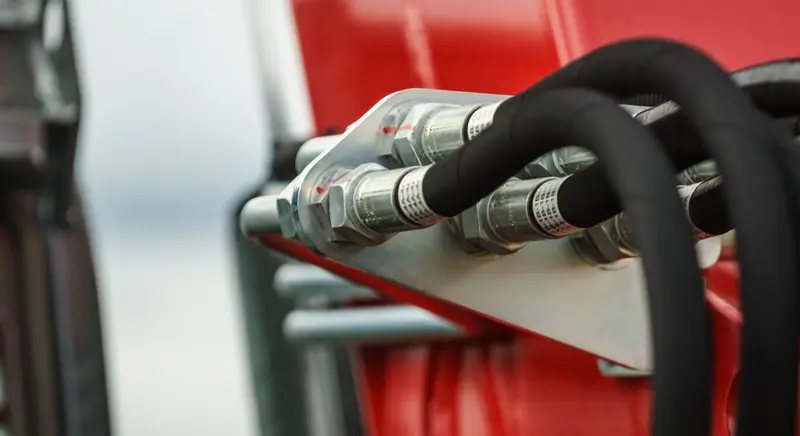
Cold storage, changing temperatures, road salt, moisture, and long idle periods can expose problems before Northeast Ohio’s busy construction season. A pre-season inspection can help a fleet find visible damage and overdue maintenance before equipment returns to full use.
This is a general planning checklist. The machine manufacturer’s operator and service manuals, approved fluid specifications, maintenance intervals, workplace procedures, and qualified personnel should control the work.
Start with records, not assumptions
Review each machine’s maintenance history, hour meter, outstanding fault codes, prior leak reports, and manufacturer service schedule. Confirm that manuals and current fluid and filter specifications are available for the exact model and configuration.
Avoid applying one fleet-wide interval or fluid choice without checking the manufacturer requirements. Equipment that looks similar can use different fluids, filters, hose constructions, pressures, and cold-start procedures.
Inspect hoses and routing with the machine in a safe state
Park and secure the machine using its approved shutdown and stored-energy procedure. Look for:
- Leaks, mist residue, or fresh fluid
- Cuts, cracks, blisters, crushing, or exposed reinforcement
- Abrasion against frames, guards, attachments, or nearby hoses
- Twisting, sharp bends, loose clamps, or incorrect support
- Damage, corrosion, or movement near fittings
- Contact with hot surfaces or moving components
Never use a hand to search for a hydraulic leak. Do not pressurize equipment simply to find a suspected pinhole. A qualified person should handle diagnosis using the manufacturer-approved method.
Check fluid condition and level the right way
Use the level-check procedure and fluid specified for the machine. Cloudiness, unusual color, foam, odor, separated water, or unexpected level changes can justify further evaluation, but appearance alone does not identify every contamination problem.
Do not automatically switch between ISO viscosity grades based only on the season or location. The correct viscosity and formulation depend on the equipment design, allowable temperature range, pump requirements, seals, and manufacturer approvals. Mixing incompatible fluids can create additional problems.
If contamination is suspected, use the manufacturer’s sampling method or a qualified fluid-analysis provider. Keep sampling equipment and containers clean so the sample itself does not introduce misleading contamination.
Inspect filters, breathers, and the reservoir
Check filter indicators, replacement intervals, reservoir seals, caps, and breathers according to the service manual. A damaged breather or seal can admit moisture and particles. A desiccant breather can be useful in some applications, but it should be properly sized and approved for the reservoir rather than treated as a universal upgrade.
Do not open a reservoir or filter housing until the system is in the required safe state and contamination controls are in place.
Follow the manufacturer cold-start and warm-up procedure
Cold fluid can increase flow resistance. The correct idle time, control movement, load restriction, and warm-up target vary by machine, ambient temperature, and fluid. Follow the operator manual rather than using a universal number of minutes.
Stop and investigate abnormal noise, sluggish response, warning indicators, foaming, or leaks. Do not keep cycling a machine in an attempt to warm through a suspected suction, cavitation, or lubrication problem.
Avoid improvised flushing
A complete hydraulic-system flush can involve large fluid volumes, trapped oil in components, contamination-control requirements, waste handling, and machine-specific procedures. Disconnecting a return line and operating the machine is not an appropriate universal DIY method.
If the manufacturer calls for flushing, follow its documented process and use qualified personnel with suitable filtration, monitoring, containment, and disposal controls.
Build a hose and equipment record
For each critical assembly, consider recording:
- Machine and hose location
- Visible layline or part number
- Photos of routing and both end connections
- Inspection date and observed condition
- Areas of recurring abrasion, heat, or movement
- Prior replacement information, when known
Documentation can make future planning easier, but it does not replace inspection criteria or specification work by a qualified person.
Build the record before the season gets busy
Connect this checklist to a consistent equipment record and review the mobile fleet hose service scope. Operators can also prepare the information a mobile hose provider will need and check service details for Columbiana County, Youngstown, Canton, Akron, or Warren.