
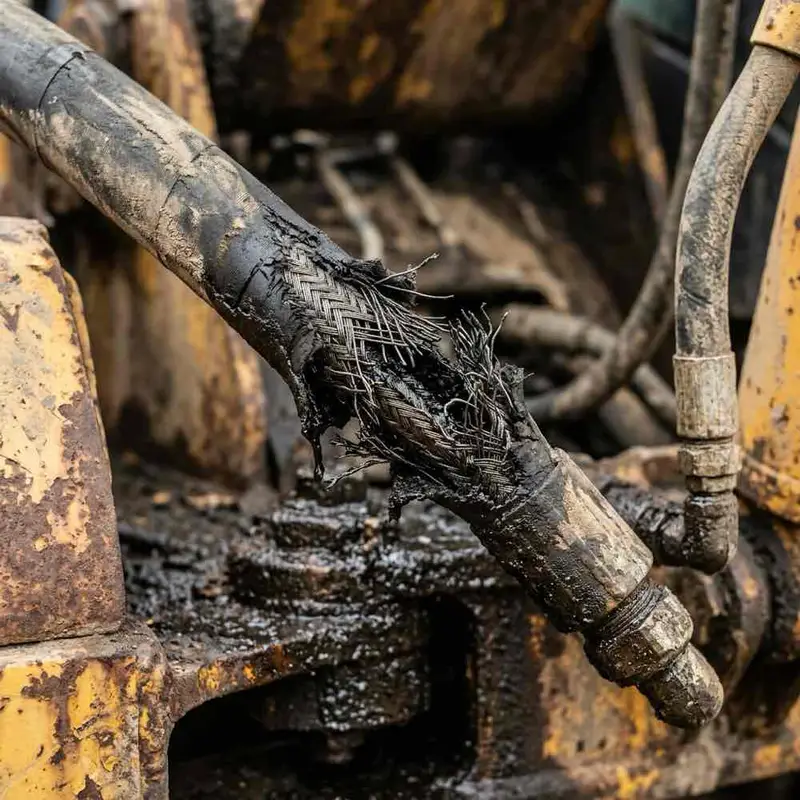
A failed hydraulic hose can release hot fluid, create slippery surfaces, move equipment unexpectedly, and leave pressure stored in cylinders or accumulators. The safest response depends on the specific machine, so its operator and service manuals, site emergency plan, and trained personnel take priority over any general checklist.
SIG Hydraulics provides mobile hydraulic hose service at equipment locations. Contact SIG with the exact location, machine details, and safely collected hose information to request service.
1. Stop work and protect people
Warn nearby workers, keep people out of the affected area, and stop operating the machine as soon as it can be done safely. Do not reach into a hose bundle or approach an active spray to find the source.
Escaping hydraulic fluid can penetrate skin. A glove does not make it safe to feel for a leak. If fluid injection is suspected—even when the wound looks small—seek emergency medical care immediately and identify the fluid involved.
2. Stabilize and de-energize the machine correctly
Follow the equipment manufacturer’s shutdown, attachment-lowering, lockout, and stored-pressure procedure. Turning off the engine alone may not remove hydraulic pressure. Raised equipment, accumulators, thermal expansion, and trapped loads can retain hazardous energy.
Do not loosen a fitting or disconnect a hose until the system has been placed in a verified safe state by someone qualified to do so. Avoid generic control-cycling instructions: the approved sequence varies by machine and system design.
3. Follow the site’s spill-response plan
Keep oil away from people, ignition sources, drains, soil, and water when this can be done without entering the hazard area. Use the containment materials and personal protective equipment specified by the site plan and the fluid’s safety data sheet.
Escalate the release according to employer procedures and applicable local, state, and federal requirements. Do not improvise cleanup in a way that exposes workers to pressure, hot surfaces, unstable equipment, or moving components.
4. Do not pressurize the system to search for the leak
Never use a hand or other body part to locate a suspected hydraulic leak. Do not have someone restart and cycle the machine while another person holds cardboard near a hose bundle. That can put people in the path of a high-pressure spray or unexpected machine movement.
A qualified technician may use manufacturer-approved diagnostic methods, guards, remote observation, and rated tools. Until then, keep the machine isolated and record only what can be observed safely with the system de-energized.
5. Collect useful information from a safe position
Information that can help an active repair provider includes:
- Machine make, model, and serial number
- Exact location, access limits, and site contact
- The function that stopped working
- Photos of the full routing and both hose ends, taken only when safe
- Visible layline, part number, dash size, or pressure marking
- Approximate hose length and fitting orientation
- Fluid type listed in the equipment documentation
- Whether an accumulator, suspended load, or environmental hazard is involved
Do not guess at fitting type or pressure rating. Similar-looking JIC, ORFS, pipe-thread, metric, and flange connections are not necessarily interchangeable. Machine documentation and the hose and fitting manufacturers’ specifications should control replacement selection.
6. Do not patch a high-pressure hose
Tape, improvised wraps, and ordinary clamps are not approved substitutes for a correctly specified hydraulic hose assembly. They can conceal the leak, introduce new failure points, and expose people to pressurized fluid. Keep the equipment out of service until the required repair is completed and checked under the applicable manufacturer and workplace procedures.
Save the information for service planning
Keep the machine details, hose routing photos, layline, fitting photos, and jobsite access information with the equipment record. Review the mobile hydraulic hose repair service scope and the information checklist for mobile hose service.