
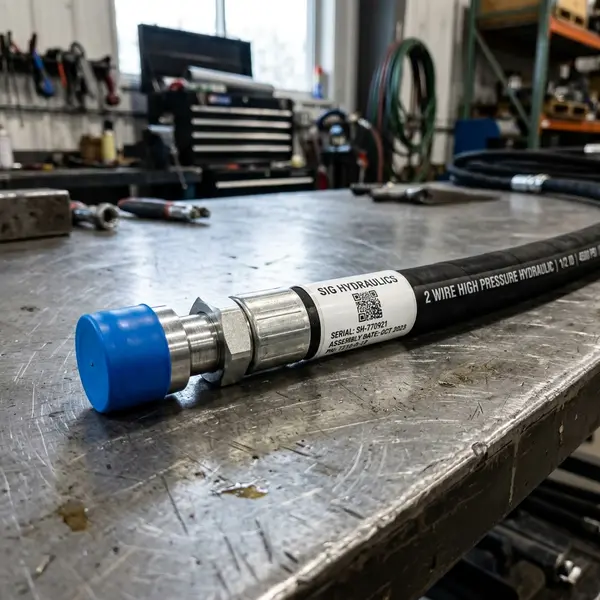
A hydraulic hose problem can stop equipment, release hot fluid, contaminate the work area, and expose people to stored pressure. A short visual check can help an operator spot obvious damage before startup, but it cannot prove that a hose is safe or predict exactly when it will fail.
Use the equipment manufacturer’s inspection procedure, replacement criteria, and lockout requirements. If a condition is unclear, keep the machine out of service and have it evaluated by a qualified person.
Safety first: never use your hand to find a leak
Escaping hydraulic fluid can penetrate skin and cause a serious injection injury. Gloves do not make it safe to touch a suspected leak. Keep people away from an active spray, shut the machine down, and relieve stored pressure only by following the procedure in the operator or service manual. Accumulators and raised attachments can retain hazardous energy after the engine stops.
Do not restart or pressurize equipment just to locate a leak unless a qualified technician is following an approved diagnostic procedure with the proper guarding and tools. If fluid injection is suspected, seek emergency medical care immediately and identify the material involved.
A practical visual-inspection routine
Before each shift, or at the interval specified by the equipment manufacturer:
- Park safely, lower attachments, and follow the machine’s shutdown and stored-energy procedure.
- Look for fresh fluid, mist residue, or wet areas from a safe distance.
- Check hose covers for cuts, abrasion, cracks, blisters, crushing, or exposed reinforcement.
- Check fittings and nearby hardware for damage, movement, corrosion, or leakage.
- Look for twisting, sharp bends, loose clamps, and contact with hot, sharp, or moving parts.
The following five conditions deserve attention.
1. Cover damage or exposed reinforcement
The outer cover protects the hose reinforcement from abrasion, weather, moisture, and chemicals. Cuts, deep cracks, missing cover material, or visible wire reinforcement mean the hose has lost part of that protection.
Surface appearance alone does not reveal the condition of the inner tube or reinforcement. Compare what you see with the hose manufacturer’s rejection criteria. Exposed reinforcement, a blister, or a deep cut generally warrants taking the equipment out of service until a qualified person evaluates the assembly.
2. Leakage or damage near a fitting
Fresh oil, mist residue, or recurring wetness near a coupling can come from several sources: the hose-to-fitting connection, the threaded or flanged connection, an O-ring, or another component above it. Do not assume that tightening a fitting will solve the problem. Incorrect torque can damage sealing surfaces or threads.
Clean-up and diagnosis should follow the equipment manufacturer’s procedure. If the source cannot be identified without pressurizing the machine, leave that work to a qualified technician using an approved test method.
3. Kinks, crushing, twisting, or a permanent sharp bend
Hydraulic hose is designed to flex within limits specified by its manufacturer. A kink, crushed section, twist, flattened area, or bend tighter than the stated minimum bend radius can damage the inner tube or reinforcement even when the cover still looks intact.
Before replacing an affected assembly, determine why the condition occurred. Hose length, routing, clamp position, fitting orientation, and the equipment’s full range of motion all influence whether the replacement will be stressed in the same place.
4. Abrasion and contact points
Hoses can rub against frames, guards, brackets, attachments, or one another as equipment moves. Polished spots, missing cover material, worn sleeves, or rubber debris indicate contact.
A replacement without a routing correction may fail in the same way. Any protective sleeve, guard, clamp, or routing change must be compatible with the hose and equipment manufacturers’ requirements and must not restrict normal movement or trap damaging heat.
Before the assembly is removed, use the hydraulic hose abrasion and routing guide to preserve the rub point, nearby contact surface, supports, and original path.
5. Heat exposure, chemical damage, or uncertain history
A hose may need attention even without an obvious leak. Hardening, softening, discoloration, swelling, brittleness, or a damaged layline can point to heat, chemical, environmental, or age-related exposure. The layline may identify the manufacturer, part number, size, standard, and pressure rating, but date-code formats vary.
There is no universal replacement age for every hydraulic hose application. Service life depends on the hose construction, storage, installation, pressure cycles, temperature, fluid, routing, environment, and the equipment and hose manufacturers’ requirements. Use documented inspection intervals and replacement criteria instead of a blanket number of years.
What to record
Photograph the complete routing and both end connections before anything is removed. Record the machine make and model, hose location, visible layline, approximate length, fitting orientation, and the condition that prompted the inspection. Do not rely on photos or appearance alone to specify a replacement; a qualified person still needs to verify the application.
Related SIG guides
Review the mobile hose repair service scope, fleet hose support, and the information to prepare before contacting a mobile hose provider.