
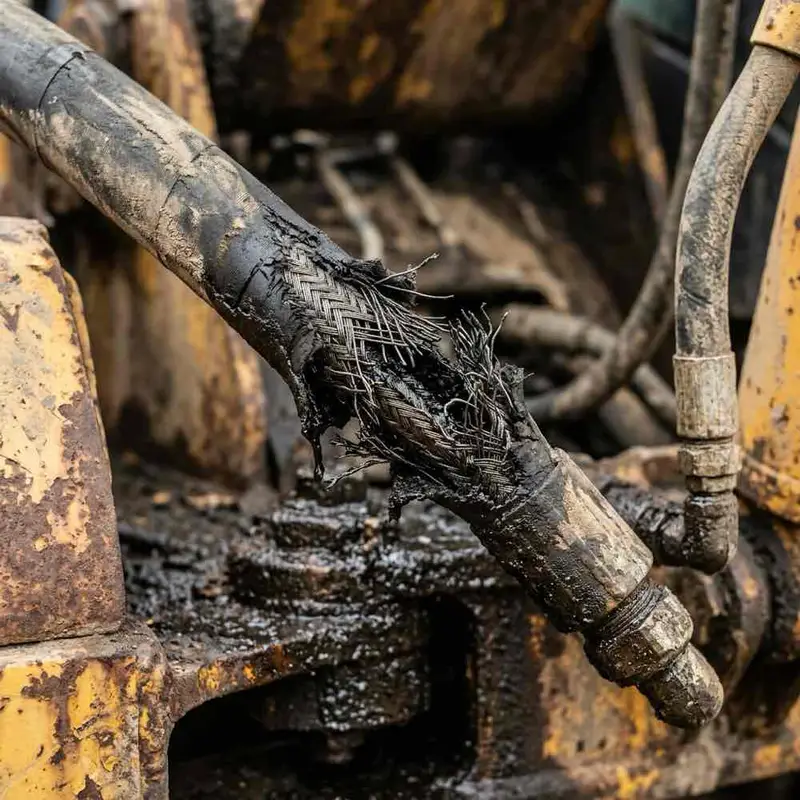
When a hydraulic hose blows on your job site, the first ten minutes matter. A blowout halts your machinery, dumps hot oil onto the ground, and creates a major safety hazard. How you handle the situation determines how quickly you get back to work and how safe your crew stays.
STEP 1: Kill the Engine & Depressurize the System
Shut down the machine immediately. Continuing to run a machine with a blown hose pumps hydraulic fluid at high pressure onto the ground, onto hot exhaust components (creating a fire risk), and toward workers.
But turning off the ignition is only the first step. You must depressurize the system. Turning off the engine does not mean the hydraulic lines are safe.
Relieving Pilot and Actuator Pressure
To relieve pressure trapped in the cylinders and lines:
- Lower all attachments: Lower excavator buckets, loader arms, or plow blades flat to the ground. If an attachment is left suspended in the air, the fluid supporting it remains under pressure.
- Cycle the controls: With the engine off and the ignition key in the “ON” or “ACCESSORY” position, cycle all hydraulic control levers and joysticks through their full range of motion multiple times. This opens the control valves and releases trapped pilot pressure back to the reservoir.
- Set the safety lock: Once cycled, put the safety lockout lever in the locked position.
The Danger of Accumulators
Many modern machines use hydraulic accumulators. An accumulator is a storage vessel containing nitrogen gas under pressure, designed to store hydraulic energy so pilot controls can operate if the engine stalls.
Accumulators can hold high pressure for minutes or even hours after the engine is shut down. If your machine has pilot accumulators, refer to your operator manual for the specific depressurization sequence, or wait for our technician to handle the line safely. Never attempt to loosen a fitting on a line connected to an active accumulator.
STEP 2: Secure the Area and Contain the Spill
Hydraulic oil is hot and extremely slippery. Keep workers away from the machine. If the oil sprayed onto gravel or dirt, deploy absorbent pads or granular clay absorbents immediately.
If the spill is near a storm drain, ditch, or creek, prioritize containment. Northeast Ohio environmental regulations impose heavy fines for oil runoff, so stopping the spread of the oil is critical.
STEP 3: Run the Cardboard Test for Pinhole Leaks
Sometimes, you have a leak but can’t see exactly where it is. You might notice your oil level dropping or see a mist of oil under the hood, but the exact hole is hidden inside a bundle of hoses.
To find the leak safely, run the cardboard test:
- Safety gear: Put on heavy safety glasses and thick gloves.
- Depressurize first: Make sure the engine is off and you have cycled the controls.
- Use a shield: Take a large piece of stiff cardboard (like a box flap) or a piece of wood. Never use your hands to feel along a hose.
- Sweep the area: Hold the cardboard a few inches away from the suspected hose bundle. Have an assistant start the machine and cycle the hydraulic controls briefly to pressurize the system.
- Locate the spot: Sweep the cardboard along the length of the hoses. When you pass over the pinhole leak, the high-pressure spray will squirt against the cardboard, leaving a dark, clear line of oil. Shut down the machine immediately once the leak is located.
STEP 4: Prepare the Technician Dispatch Checklist
When you call SIG Hydraulics for an emergency mobile repair, we want to get to your site and get you running as fast as possible. You can speed up our response by reporting specific details about the failed hose.
Run through this Technician Dispatch Checklist before you call:
- Inner Diameter (Dash Size): Hydraulic hoses are measured in sixteenths of an inch. Look at the layline text on the hose. You will see a number like
-4,-8,-12, or-16.- A
-8hose has an inside diameter of 8/16", or 1/2". - A
-12hose is 12/16", or 3/4".
- A
- Hose Construction Type: Does the layline say
SAE 100R2(2-wire braid) orSAE 100R12/15(4-spiral steel)? Spiral hoses are thicker and stiffer, designed for high-pressure main pumps. - End-Fitting Styles: Look at the couplings on both ends. Are they straight, or do they bend at an angle (like a 45-degree or 90-degree elbow)?
- Fitting Threads: Identifying the thread type helps our tech pre-stage the correct fittings. The most common types are:
- JIC (Joint Industry Council): Has a 37-degree flared nose on the male end and a matching seat on the female nut.
- ORFS (O-Ring Face Seal): Has a flat sealing face with a recessed rubber O-ring. Very common on newer CAT, John Deere, and Case construction equipment.
- NPT (National Pipe Thread): Has tapered threads that seal as they are tightened.
- Metric DIN / BSPP: Commonly found on imported European or Japanese machinery (like Kubota, JCB, or Hitachi).
- Approximate Length: Measure the length of the hose from the tip of one fitting to the tip of the other.
If the layline is worn off or you can’t identify the threads, don’t worry. Our trucks carry a complete inventory of sizes and styles. We will identify it when we arrive.
The Danger of “Dummy Fixes”: Why Tape and Clamps Do Not Work
When you are in a rush to hit a deadline, it is tempting to try a quick fix. You might think, “I can wrap this leak with heavy-duty silicone tape, put a hose sleeve on it, and tighten a few gear clamps over it to get through the day.”
Never try to patch a hydraulic hose. This is extremely dangerous.
Here is why:
- The Pressure is Too High: Standard duct tape, silicone repair tape, or rubber wraps are designed for low-pressure water lines (under 100 PSI). High-pressure hydraulic systems operate at 3,000 to 5,000 PSI. The fluid will tear through any tape or rubber wrap instantly.
- Clamps Create Shrapnel: A metal hose clamp tightened over a split hose will not stop the leak. Instead, the pressure will build under the clamp, eventually rupturing the hose around it and potentially blowing the clamp apart, turning it into metal shrapnel.
- Increases Injection Risk: A taped hose often converts a visible oil spray into a hidden, high-velocity pinhole spray that shoots out from the edges of the tape. This raises the risk of a crew member accidentally suffering a hydraulic injection injury while working near the machine.
There are no temporary patches for high-pressure hydraulic hoses. The only safe repair is a complete replacement of the hose assembly.
Contact Your Northeast Ohio Mobile Service
At SIG Hydraulics, we keep our mobile units fully stocked and ready to dispatch 24/7. When a line blows, follow these safety steps, pull your dispatch checklist together, and call us at (234) 575-4160 or contact us to request dispatch. We serve Salem and all surrounding counties including Columbiana County and Mahoning County, getting your crew back to work safely.