
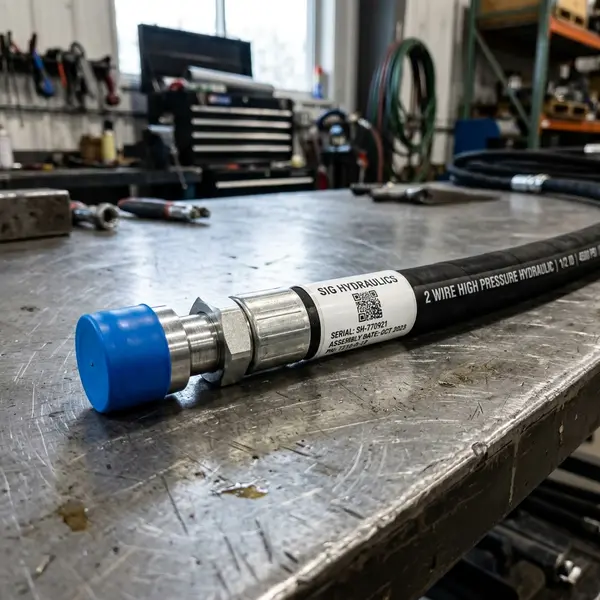
A hydraulic hose failure on a construction site doesn’t just stop one machine; it can shut down an entire operation. The excavator bucket freezes. The steering on your loader goes limp. Fluid pours into the dirt. The average downtime cost for heavy equipment runs $500 to $1,500 per hour when you factor in idle crew, missed deadlines, environmental clean-up costs, and emergency repair premiums.
The good news? Most hose failures give warning signs well before they blow. Catching these signs early keeps your job site moving and keeps your crew safe.
🚨 CRUCIAL SAFETY FIRST: Understanding Hydraulic Injection Injuries
Before you inspect any machine, you must understand the severe hazard of high-pressure fluid leaks. High-pressure hydraulic systems operate from 2,000 PSI up to 6,000 PSI. If fluid escapes through a pinhole leak at these pressures, it behaves like a cutting jet. It easily punctures heavy leather work gloves and penetrates human skin.
This is called a hydraulic injection injury, and it’s a critical medical emergency.
- The Trap: An injection injury often feels like a minor pinprick or a bee sting when it happens. Operators sometimes ignore it, thinking it’s just a splinter. But the oil travels deep into the tissue. The body cannot process or reject petroleum-based fluids.
- The Progression: Within hours, the fluid causes chemical burns, severe swelling, and cuts off blood circulation. If left untreated, the injury leads to tissue necrosis and often requires amputation.
- The Rule: Never search for a hydraulic leak using your bare hands or even gloved hands. Always depressurize the system first. If you must inspect a pressurized line, use a piece of cardboard or wood. Sweep it slowly along the hose. If there’s a pinhole leak, you’ll see a dark spot appear on the cardboard.
- If Injected: Go to an emergency room immediately. Tell the triage nurse that you have a high-pressure hydraulic injection injury. It requires immediate evaluation by a specialized surgeon to clean out the oil.
📋 The Operator’s Shift Checklist (Pre-inspection Cab Card)
To keep inspections consistent, have your operators run through this quick checklist before starting every shift. You can print this and laminate it for the machine cab:
- [ ] Clean Inspection: Wipe down heavy grease buildup near crimp fittings to check for weeping fluid.
- [ ] Routing Check: Verify that no hoses are twisted, pinched, or rubbing against frame brackets.
- [ ] Braid Inspection: Scan the length of each hose for exposed steel wire reinforcement.
- [ ] Fitting Inspection: Check for cracks in metal couplings or signs of collar slippage.
- [ ] Drip Check: Look under the machine’s main pump and valve blocks for fresh oil pooling.
1. OUTER COVER CRACKING OR WEATHERING (Rubber Degradation)
Rubber is an organic compound. Over time, environmental factors degrade it. Northeast Ohio winters bring extreme cold, and summers bring intense heat. This temperature swing causes the rubber cover to expand and contract. Combined with constant UV exposure and atmospheric ozone, the rubber loses its plasticizers and hardens.
When rubber degrades, it loses its elasticity. Small surface cracks form first. While surface cracks are common and don’t immediately threaten the hose’s pressure capacity, they are the first warning sign. As the degradation deepens, these surface cracks turn into deep fissures.
Once a crack goes deep enough to expose the steel wire reinforcement underneath, the hose is on borrowed time. Moisture and road salt will enter the fissures, causing the steel braids to rust and fail.
What to do: If you see exposed wire braids inside the cracks, replace the hose immediately. If you only spot surface-level cracking, log the hose for replacement during your next scheduled maintenance window.
2. LEAKING AT FITTINGS (Crimp Separation)
A damp fitting is the most common early warning of a blowout. You’ll usually spot a slow weep of oil where the rubber hose meets the metal crimp collar. This weep tells you that the seal between the inner tube and the coupling has been compromised.
This separation happens for three reasons:
- Cold Flow: Over time under pressure and heat, rubber naturally deforms. This makes the grip of the metal ferrule loose.
- Improper Crimping: If the hose was built with incorrect crimp specifications, the collar might have been under-crimped.
- Vibration Fatigue: Heavy vibration on active machinery stresses the connection point where the flexible hose meets the rigid metal fitting.
Once a weep starts, the hose is slowly pushing its way out of the collar. Under a heavy load or pressure spike, the fitting can blow off completely, dumping your entire oil reservoir.
What to do: Don’t tighten the adapter and hope the leak stops. Tightening the thread does not fix a loose crimp collar. The assembly must be cut off and replaced. Our mobile hose repair trucks can provide custom hose fabrication right at your machine.
3. KINKS OR PERMANENT SET (Braid vs. Spiral Failures)
A healthy hydraulic hose is flexible and returns to its natural straight shape when depressurized. If a hose holds a sharp bend, has a permanent twist, or feels flat at a certain point, the internal reinforcement structure has failed.
To understand why this is dangerous, you must look at how hoses are built:
- SAE 100R2 (Wire Braid): These hoses use two layers of woven steel wire. They are highly flexible and common in low to medium-pressure applications. When a braid hose kinks, the woven wires fold over each other. This creates a permanent weak spot that restricts fluid flow and raises fluid velocity.
- SAE 100R12 / 100R15 (Spiral Steel): High-pressure systems use spiral-reinforced hoses, where four or six layers of thick steel wire wrap around the hose parallel to each other. These hoses handle working pressures up to 6,000 PSI. While spiral hoses are highly resistant to kinking, they can suffer from internal wire separation. If a spiral hose is bent past its minimum bend radius, the steel layers separate, creating a weak zone. The hose holds a “permanent set,” indicating internal structural damage.
What to do: Replace the hose immediately. Check the routing layout. A kink or tight bend means the hose is too short or doesn’t have the correct angled fitting (like a 45-degree or 90-degree elbow) to handle the range of motion.
4. ABRASION WEAR ON THE OUTER COVER
Abrasion is the number one cause of hydraulic hose failure in the field. When hoses flex during operation, they rub against frame rails, brackets, engine shields, and neighboring hoses. The constant friction wears away the protective rubber outer cover.
Once the rubber is gone, the steel reinforcement wire is exposed. As the wires rub against the metal frame, they fray and snap. A wire braid hose with 10 percent of its wires frayed has lost more than half of its pressure rating.
What to do: When replacing an abraded hose, you must address the routing. Install protective sleeves or wraps. We recommend:
- Nylon Abrasion Sleeves: These slide over the hose and absorb the friction, protecting the rubber underneath.
- Plastic Spiral Guards: Heavy plastic coils protect against impact and scraping in rocky or timber environments.
- Routing Blocks: Use heavy clamp blocks to hold parallel hoses apart, preventing them from rubbing against each other.
5. HOW TO READ A LAYLINE (Understanding Service Life)
Even if a hose looks perfect on the outside, the internal rubber tube is aging. Over years of service, hot oil (often reaching 180°F to 200°F) degrades the inner rubber compound, making it brittle. Eventually, the brittle tube cracks, allowing oil to seep to the wire reinforcement.
To prevent age-related blowouts, you need to know how old your hoses are. Every industrial hose has a layline—a strip of text running along its length.
Here is how to read a typical layline:
AEROQUIP GH662-16 SAE 100R2AT 1" WP 2000 PSI 4Q22
- Manufacturer:
AEROQUIPis the brand. - Part Number:
GH662is the specific hose model. - Dash Size:
-16is the inner diameter in sixteenths of an inch. A dash 16 means 16/16", or a 1-inch hose. - Specification:
SAE 100R2ATis the industry standard (two-wire braid). - Working Pressure:
WP 2000 PSIis the maximum safe operating pressure. - Date Code:
4Q22means the hose was manufactured in the 4th Quarter of 2022. Some laylines use Julian dates (e.g.,22150meaning the 150th day of 2022).
Industry standards (including ISO 17165-2) recommend a maximum service life of 5 to 7 years from the manufacture date. If a hose has been running on a machine for six years, it is time to schedule a proactive replacement.
Bottom Line
Catching a bad hose before it blows saves you money and keeps your crew safe. A proactive hose replacement, scheduled through a fleet preventive maintenance program, costs a fraction of an emergency repair, fluid cleanup, and lost productivity.
At SIG Hydraulics, we carry the inventory and heavy tooling to keep your systems running. If you spot a suspect line, don’t wait. Call us at (234) 575-4160 or stop by our Salem shop. We’re here to help you get it Plumbed Right.